Why Your T-Shirt Fits Your Chest but Hangs Loose at the Waist
If your T-shirt fits your chest but hangs loose around your waist, the problem is usually the shirt's proportions—not necessarily the size you're wearing. Many standard men's T-shirts are cut relatively straight from the chest through the torso. If your chest and shoulders are substantially wider than your waist, you may need an athletic or tapered fit instead.
This used to drive me crazy.
I'd try on a T-shirt and the top half would look almost perfect.
Shoulders?
Good.
Chest?
Good.
Sleeves?
Good.
Then I'd look down.
There would be all this extra fabric hanging around my stomach and lower back.
So I'd do what I think a lot of guys do.
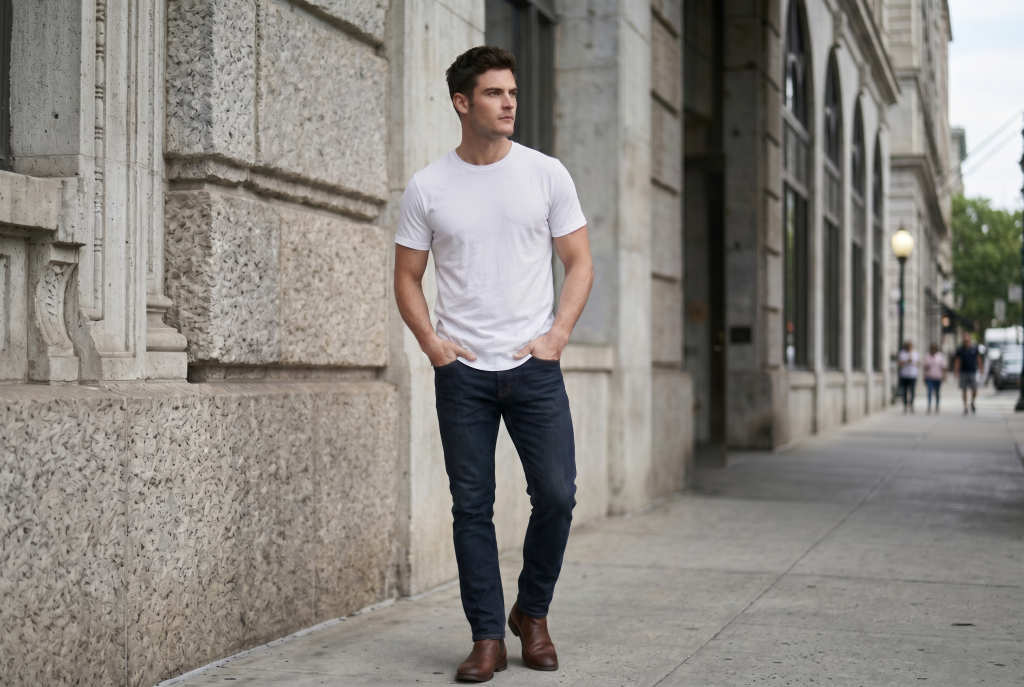
I'd size down.
Now the waist looked better—but everything else was too tight.
My chest pulled against the fabric. The sleeves squeezed my arms. The shoulders felt restrictive.
Eventually I realized something:
I didn't need a smaller T-shirt. I needed a differently shaped T-shirt.
If you've got a bigger chest and shoulders relative to your waist, that's an important distinction.
Your T-Shirt Is Probably Doing Exactly What It Was Designed to Do
The easiest way to understand the problem is to think about the shape of a standard T-shirt.
A lot of men's tees are relatively straight through the torso.
That works perfectly well if your chest and waist measurements aren't dramatically different.
But now imagine a guy with:
Broad shoulders.
A 44-inch chest.
A 34-inch waist.
Developed arms.
The shirt and body are shaped differently.
To get enough room across his chest, he chooses a size large.
But that large is also designed with enough room through the stomach for guys who carry more size there.
The result?
The chest fits. The waist floats.
That's why this problem is especially common among guys who lift.
Sizing Down Usually Doesn't Fix It
This was my mistake.
If there's too much material around the stomach, buying a smaller shirt seems logical.
Sometimes that works.
But if your shoulders and chest already fit correctly, you're fixing one measurement by ruining three others.
You end up with:
- Shoulder seams sitting too far inward
- Fabric pulling across your chest
- Sleeves digging into your arms
- Restriction across your upper back
- Wrinkles radiating outward from the chest
- A shirt that rides up when you move
The waist might look better.

But the shirt doesn't actually fit better.
A smaller regular-fit shirt isn't the same thing as an athletic-fit shirt.
That's probably the most important point in this article.
What You Actually Need Is More Taper
A tapered T-shirt has a different relationship between its upper and lower measurements.
You still get the space needed through the:
Shoulders
Chest
Upper back
But the torso gradually becomes narrower toward the waist.
That's much closer to the proportions of someone with an athletic V-shaped build.
Think:
Room where you're big.
Less fabric where you're smaller.
It sounds obvious.
But once I understood that, shopping for shirts became much easier.
Instead of asking:
"Should I buy a medium or a large?"
I started asking:
"How is this shirt actually cut?"
Regular Fit vs. Athletic Fit
Here's the practical difference I look for:
| Area | Regular T-Shirt | Athletic-Fit T-Shirt |
|---|---|---|
| Shoulders | Standard room | Room for developed shoulders |
| Chest | Standard | More accommodating |
| Arms | Often looser | Usually more fitted |
| Waist | Straighter | More tapered |
| Upper back | Standard | More mobility/room |
| Overall shape | Rectangular | More V-shaped |
Not every brand uses these terms consistently.
One company's "slim fit" might be another company's regular fit.
That's why I care more about how the actual shirt is constructed than whatever word appears on the product page.
This Is Exactly Why We Built the Ten/10 Curved Hem Tee Differently
This fit problem is one of the reasons I care so much about the silhouette of the Ten/10 Curved Hem Tee.
I didn't want to solve the loose-waist problem by simply making the entire shirt tighter.
That's easy.
But then guys with bigger shoulders, chests and arms are right back where they started.
The goal is an athletic form fit.
The shirt follows the upper body while maintaining a cleaner shape as it moves down toward the waist.
Our Velura™ fabric also uses a blend of polyester, cotton and spandex.
That stretch matters.
Because once you make a T-shirt more fitted, the fabric needs to move.
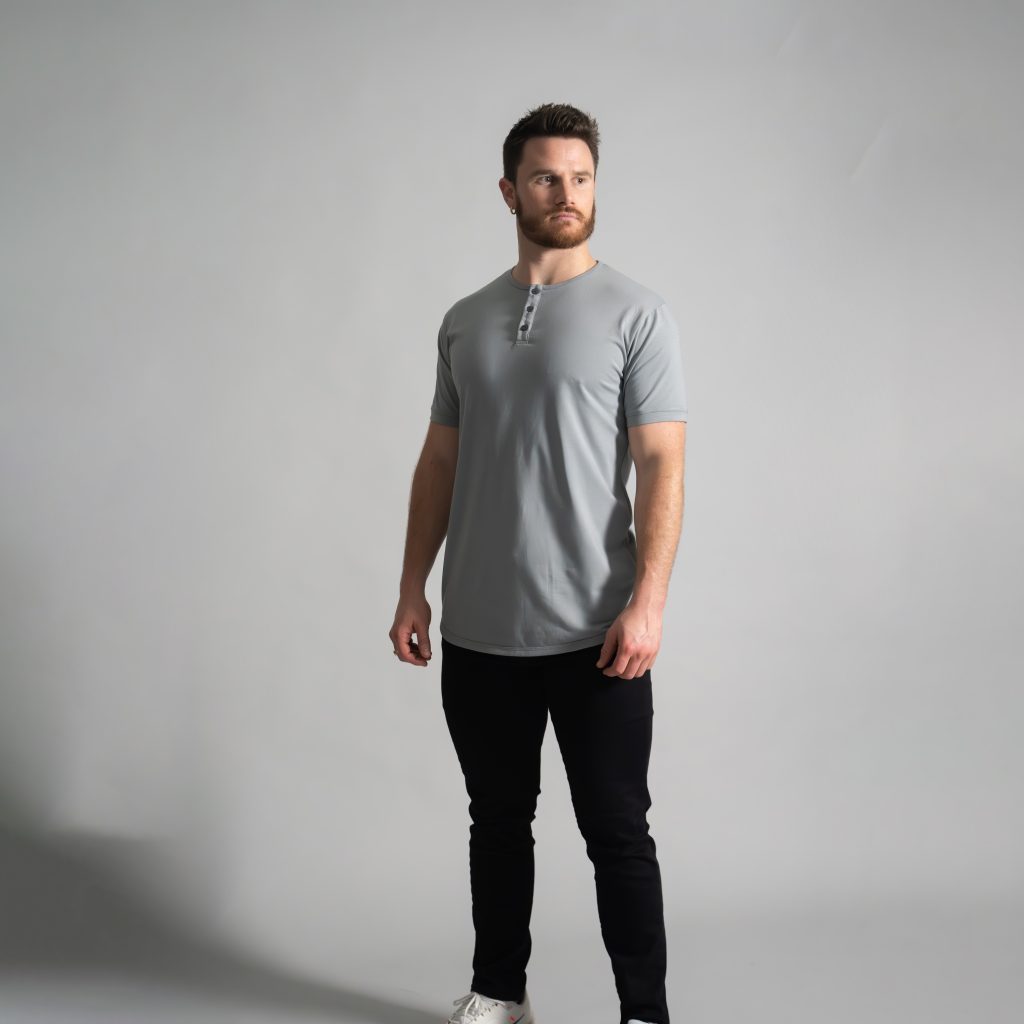
I want the shirt to sit closer to my body while I'm standing still, but I also need to be able to:
Reach forward.
Cross my arms.
Drive.
Pick something up.
Move normally.
A good fitted T-shirt shouldn't remind you every 30 seconds that you're wearing a fitted T-shirt.
Why Your Chest-to-Waist Ratio Matters
This is really the underlying issue.
Two men can weigh exactly the same and need completely different shirts.
Imagine two guys who are both 5'10" and 185 pounds.
One carries more of his weight through his torso.
The other lifts regularly and has more size through his chest, back and shoulders with a smaller waist.
Same height.
Same weight.
Completely different proportions.
That's why buying T-shirts based on height and weight alone isn't always enough.
If you've got a substantial difference between your chest and waist measurements, you're much more likely to experience the:
"fits my chest, baggy around my stomach"
problem.
The Back Can Create the Same Problem
This isn't just about having a big chest.
Guys with developed backs run into it too.
Lats add width to the upper torso.
If you train your:
Latissimus dorsi.
Traps.
Rear delts.
Upper back.
...you may need considerably more material through the top half of a shirt.
But your waist hasn't necessarily gotten any larger.
So you size for your upper back and end up swimming in fabric lower down.
That's why I've written separately about shirts that make your back look bigger and the best shirts for broad shoulders.
They're all variations of the same problem:
Most shirts aren't automatically proportioned for every body shape.
Your Sleeves Are Another Clue
Here's a quick way to tell whether you're dealing with a sizing problem or a cut problem.
Look at your sleeves.
If the shirt fits your chest but the sleeves are also extremely loose, the entire shirt may simply be too large.
But if:
Your shoulders fit.
Your chest fits.
Your sleeves sit nicely around your arms.
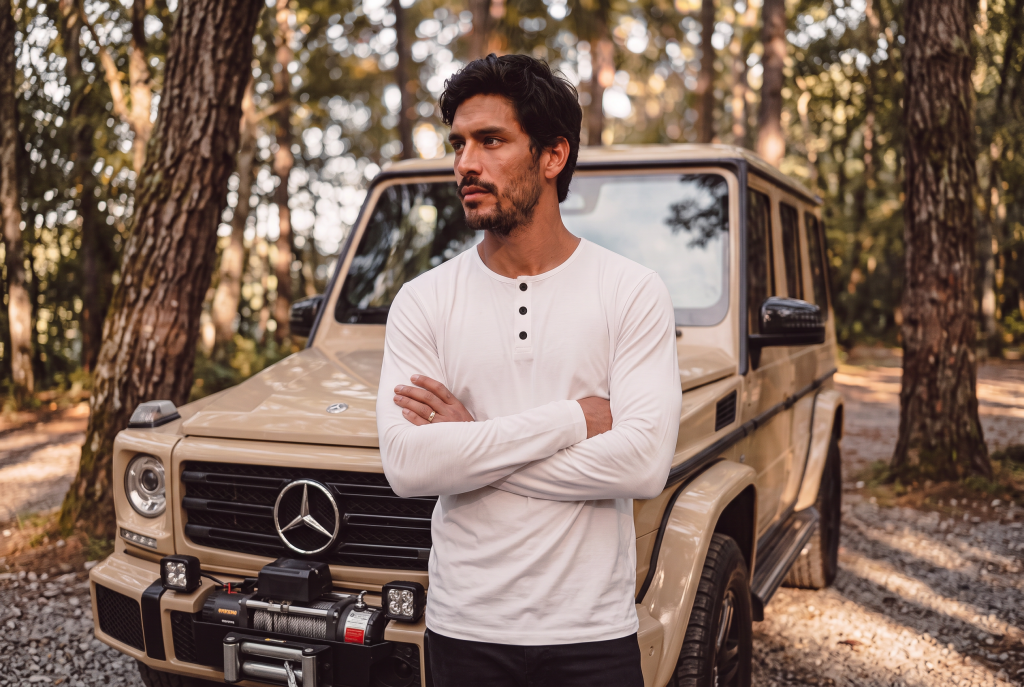
And only the waist is excessively loose...
that's a strong sign that the shirt's torso shape isn't ideal for you.
That's when I'd start looking at tapered or athletic-fit T-shirts rather than automatically going down a size.
Slim Fit and Athletic Fit Aren't the Same Thing
This distinction matters.
A slim-fit shirt generally reduces room throughout the garment.
That can mean:
Smaller chest.
Narrower shoulders.
Narrower torso.
Tighter arms.
For a naturally thin guy, that can work really well.
For a muscular guy?
Not necessarily.
If your problem is:
large upper body + smaller waist
you don't necessarily need the whole shirt slimmed down.
You need the lower torso tapered relative to the upper torso.
That's why I prefer the term athletic fit.
It's describing a different proportion rather than simply a smaller shirt.
1. Curved Hem Tee — My Everyday Solution
If I want the simplest solution to this problem, I go with the Curved Hem Tee.
The athletic silhouette handles the chest-to-waist difference.
Then the curved bottom helps finish the shirt without creating such a rigid horizontal line across the waist.
That's one reason our article on why curved hem T-shirts are some of the best-fitting men's tees has become such an important part of this conversation.
The hem doesn't replace proper taper.
It complements it.
Does a Curved Hem Actually Make Your Waist Look Smaller?
It can change the visual effect.
A traditional straight hem creates a horizontal line across the lower torso.
If the shirt is already loose there, that can reinforce the boxy shape.
A curved hem rises along the sides while extending lower through the front and back.
That creates more visual movement instead of one straight cutoff.
I find that especially flattering when the shirt itself is already tapered.
But there's an important caveat.
A curved hem cannot rescue a badly fitting torso.
If you've got six inches of excess material around your stomach, changing the shape of the bottom isn't solving the real problem.
Fit first.
Hem second.
2. Heritage Curved Hem Tee — When I Want More Drape
The Heritage Curved Hem Tee approaches the same fit problem with a different fabric.
Our Aero-Blayde™ material uses rayon, nylon and spandex.
The thing I notice here is drape.
A softer, more fluid fabric can follow the upper body and then fall naturally through the torso.
That's useful if you want a fitted shirt without the fabric looking rigid.

And the high stretch content gives the shirt room to accommodate movement through a larger upper body.
This is the version I'd choose when I want the T-shirt itself to feel more premium.
Don't Go Too Far in the Other Direction
There's also such a thing as too much taper.
I've seen muscle-fit shirts that basically look painted on.
That's not what I'm after.
If the fabric is pulling horizontally across your stomach, the waist is too tight.
If your belly button is clearly visible through the fabric?
Too tight.
If every time you eat lunch you suddenly regret your shirt choice?
Probably too tight.
I want the fabric to follow the body, not vacuum-seal it.
That's the difference between flattering and restrictive.
What If You Have a Big Chest and a Bigger Stomach?
Then I wouldn't recommend aggressive taper. I would actually recommend a relaxed fit tee without the taper.
This is important because "big chest" doesn't automatically mean "small waist."
If you have a developed upper body but also carry more weight through your midsection, you need enough room for both.
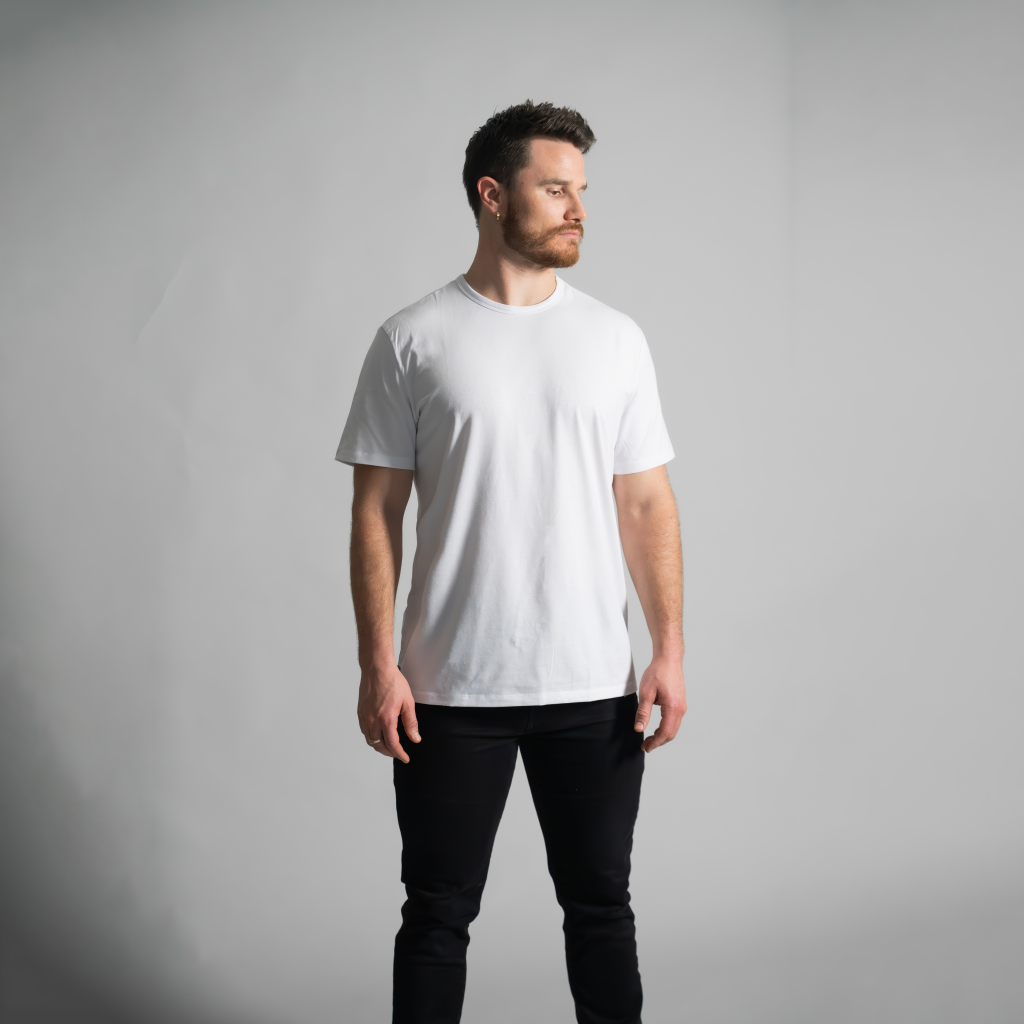
In that case, I would prioritize:
Proper shoulders.
Enough chest room.
Fabric that skims the stomach.
Stretch.
Appropriate length.
You don't need to force yourself into an athletic-cut shirt just because you lift.
The best-fitting shirt is the one shaped for your actual body.
3. Heritage Long Sleeve — The Same Problem Happens With Long Sleeves
The chest-to-waist issue doesn't disappear when the temperature drops.
In fact, I sometimes notice it more.
A traditional long-sleeve tee already has more visual fabric.
If the torso is also loose, the whole shirt can start looking oversized even when the shoulders fit correctly.
That's why I like applying the same principles to the Long Sleeve Curved Hem Tee.
Room through the upper body.
Stretch for movement.
Cleaner torso.
Curved bottom.
The goal is consistency.
I don't want all my short-sleeve shirts fitting properly and then spend fall wearing long-sleeve rectangles.
Henleys Can Be Even More Flattering
This is another option I'd consider if you have a big chest and smaller waist.
A Henley adds a vertical button placket through the upper chest.
That naturally draws the eye toward the upper body.
Combine that with:
Fitted shoulders.
Developed arms.
A tapered torso.
And you get a shirt that works extremely well with an athletic build.
Our Long Sleeve Henley Curved Hem is a good example.
The placket adds visual structure while the athletic cut prevents the bottom half from becoming excessively loose.
That's also why I think Henleys are among the best long sleeve shirts for muscular men.
How Much Loose Fabric Is Too Much?
A T-shirt shouldn't be skin-tight around your stomach.
So don't mistake every fold for a fit problem.
Fabric has to move.
You're going to see some natural material around the torso when you:
Sit.
Twist.
Bend.
Raise your arms.
That's normal.
What I'm looking for is excessive volume when I'm simply standing naturally.
A quick test:
Grab the fabric around the side of your waist.
If you're pulling away a huge handful while the chest fits correctly, you probably need a more tapered cut.
Don't obsess over getting an exact number of inches.
Look at the overall silhouette.
How I Test a T-Shirt Before Deciding It Fits
I don't just stand straight in front of a mirror anymore.
I do five things.
1. Raise My Arms
The entire shirt shouldn't fly halfway up my torso.
2. Reach Forward
I want enough upper-back mobility.
3. Look From the Side
This is where excessive stomach fabric becomes obvious.
4. Sit Down
A shirt that looks great standing can bunch terribly when seated.
5. Look at the Back
Make sure the taper isn't creating excessive pulling across the lats.
If it passes all five, I'm much more confident in the fit.
What About T-Shirt Length?
Length can make the loose-waist problem look even worse.
An overly long, straight shirt creates even more fabric below your chest.
Now you're not just dealing with width.
You're dealing with width + length.
That's when the shirt really starts looking boxy.
For an untucked athletic tee, I want enough length for coverage without the shirt extending excessively down the thighs.
Our guide on How Long Should a Curved Hem Shirt Be? goes deeper into getting that proportion right.
Why Stretch Fabric Helps Muscular Guys
A lot of traditional T-shirts need extra physical room because the fabric itself doesn't move much.
Stretch changes that equation.
If the material can expand through the:
Chest.
Back.
Shoulders.
Arms.
...the shirt can maintain a closer silhouette without restricting you as much.
That's one reason you'll see spandex or elastane included in many fitted performance shirts.
It doesn't mean the shirt needs to feel like gym compression gear.
A relatively small percentage can make a noticeable difference in movement and recovery.
Your T-Shirt Should Follow Your Body—Not Hide It
This is probably the simplest way I can explain what I want.
If I've spent years developing my shoulders, chest and back, I don't necessarily want my shirt to hang straight down from the widest point of my body.
That hides the shape underneath.
But I also don't want to wear something so tight that it looks like I'm deliberately trying to show every muscle.
The middle ground is:
Follow the body.
Shoulders fit.
Chest fits.
Arms fit.
Torso gradually tapers.
Fabric still moves.
That's the silhouette I'm after.
Style Resources
For broader guidance on how a men's T-shirt should sit through the shoulders, chest, sleeves and torso, GQ Styleregularly covers T-shirt fit, proportions and contemporary menswear.
Primer Magazine is another useful resource for practical men's fit advice, particularly for guys who want everyday clothing to look better without getting overly fashion-focused.
Related Ten/10 Articles
Frequently Asked Questions
Why does my T-shirt fit my chest but look baggy around my stomach?
Your chest-to-waist proportions may be different from the proportions of the shirt. Many standard T-shirts are cut relatively straight through the torso, so sizing for a larger chest can leave excess material around a smaller waist.
Should I size down if my T-shirt is loose around the waist?
Not necessarily. If the shoulders, chest and arms already fit properly, sizing down may make the upper body too tight. An athletic or tapered fit may solve the problem better.
What type of T-shirt is best for a big chest and small waist?
I'd look for an athletic-fit or tapered T-shirt that provides enough room through the chest and shoulders while narrowing through the torso.
What's the difference between slim fit and athletic fit?
Slim-fit shirts generally reduce room throughout the garment. Athletic-fit shirts are intended to accommodate a larger upper body while maintaining a narrower waist. Exact definitions vary by brand.
Should a T-shirt be tight around the waist?
No. I want a shirt to follow the torso without clinging tightly to the stomach. Some room is necessary for comfort and movement.
Why are all my shirts baggy around my waist?
If this happens across multiple brands while your shoulders and chest fit properly, your body proportions may simply be more tapered than the standard cuts you're buying. Try shirts specifically designed around an athletic or tapered silhouette.
Are curved hem T-shirts good for a V-shaped body?
They can be. I particularly like combining a curved hem with an athletic torso because the rounded bottom complements the tapered silhouette and works well when worn untucked.
What's the best Ten/10 shirt for a big chest and smaller waist?
I'd start with the Curved Hem Tee for everyday wear. If you want a more premium fabric with greater stretch and drape, I'd move to the Heritage Curved Hem Tee.
Final Thoughts: Stop Trying to Fix the Waist by Ruining the Chest
That was the lesson for me.
When my shirt looked too loose around my stomach, I assumed I needed a smaller size.
I didn't.
My chest was already telling me I had the correct size.
The problem was everything happening underneath it.
Once I started paying attention to taper instead of just size, T-shirts made a lot more sense.
If your shirt:
Fits your shoulders.
Fits your chest.
Fits your arms.
But hangs like a curtain around your waist...
don't automatically go down a size.
Look for a shirt designed with more shape through the torso.
That's exactly where something like the Ten/10 Curved Hem Tee or Heritage Curved Hem Tee makes sense.
Because the goal isn't to squeeze yourself into the smallest shirt you can wear.
It's to find a shirt whose proportions actually match yours.

Why Curved Hem T-Shirts Look Better Untucked
Are Curved Hem T-Shirts Still in Style in 2026?