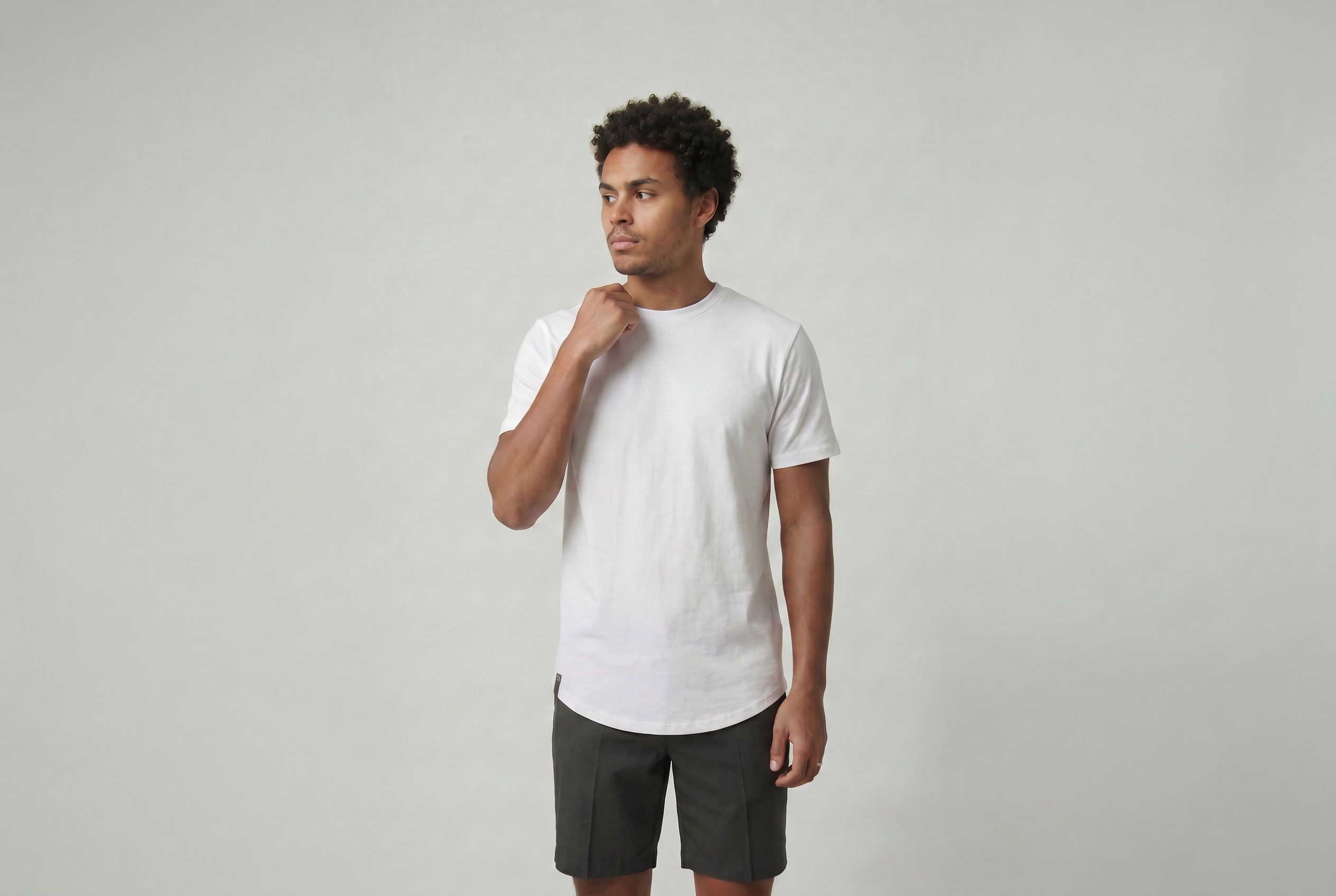
How Do I Know If My Shirt Passes the Raise-Your-Arms Test?
Your shirt passes the raise-your-arms test if you can lift both arms overhead comfortably and the shirt returns close to its original position when you lower them. Some upward movement is completely normal. The warning signs are excessive riding up, major bunching around the chest or stomach, exposed skin, restricted shoulders, or having to pull the shirt back down afterward.
I started paying attention to this because I've had plenty of T-shirts that looked great in the mirror.
Standing still.
Arms down.
Shoulders back.
Perfect.
Then I'd reach for something on a shelf and half the shirt would come up with me.
I'd put my arms back down and the T-shirt would stay bunched around my stomach.
Then came the familiar move:
Grab the bottom of the shirt and pull it back down.
If you're doing that all day, there's a decent chance the shirt doesn't fit as well as you think it does.
That's why I like what I call the raise-your-arms test.
It takes about five seconds, and it can tell you quite a bit about your shirt's shoulders, armholes, chest, length and stretch.
What Is the Raise-Your-Arms Shirt Fit Test?
It's exactly what it sounds like.
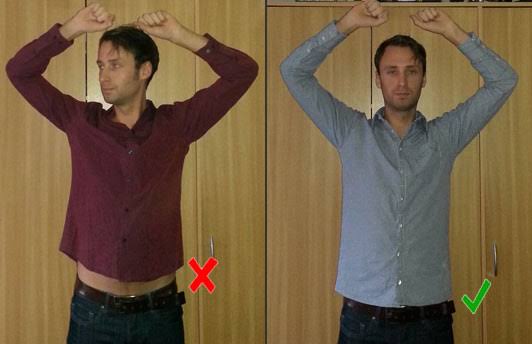
Put your shirt on normally.
Stand naturally.
Then:
- Raise both arms straight over your head.
- Pay attention to how far the shirt moves upward.
- Lower your arms.
- See where the shirt ends up.
That's it.
I'm not expecting the bottom of the shirt to remain completely stationary.
Every T-shirt is going to move somewhat when you raise your arms.
Your shoulders rotate.
Your arms move.
Your torso stretches.
The fabric has to go somewhere.
What I'm looking for is whether the shirt moves with my body or gets dragged dramatically upward because the upper half of the garment doesn't have enough mobility.
What Does Passing the Test Look Like?
A shirt passes my test when I can raise my arms naturally without thinking about the shirt.
The fabric moves upward somewhat.
I still feel comfortable through my shoulders and chest.
Then I lower my arms.
The shirt falls mostly back into place.
Maybe I need a tiny adjustment.
But I'm not yanking the entire shirt six inches downward.
That's the difference.
| What Happens | What It May Mean |
|---|---|
| Slight movement upward | Normal |
| Shirt falls back naturally | Good sign |
| Mild wrinkling around waist | Usually normal |
| Hem rises dramatically | Check fit/length |
| Shirt stays bunched after lowering arms | Possible mobility problem |
| Chest feels restrictive | May be too tight |
| Shoulder fabric pulls heavily | May need more shoulder room |
| Stomach becomes exposed | Shirt may be too short and/or restrictive |
| Collar gets pulled upward | Upper-body fit may be too tight |
| You immediately pull the shirt down | Worth investigating |
I wouldn't judge a shirt based on one measurement alone.
I'm looking at the whole movement pattern.
Your Shirt Is Supposed to Move
This part is important because I don't want guys doing this test and assuming their shirt failed because the hem moved an inch.
That's not realistic.
Your T-shirt isn't attached to your pants.
When you lift your arms overhead, your shoulder joint moves and the muscles around your upper body change position. Your shirt has to accommodate that movement.

So some riding up is normal.
The question is:
How much does it move, how does it feel, and what happens when your arms come back down?
That's much more useful than trying to create an exact universal number.
The Biggest Red Flag: Your Shirt Doesn't Come Back Down
This is the thing I notice most.
Raise your arms.
Lower them.
Now look at the shirt.
Did it mostly return to where it started?
Or is the entire torso bunched around your stomach?
If it's bunched, I start looking at the upper-body fit.
A shirt that's too restrictive through the shoulders, chest or armholes can get pulled upward as your arms rise.
Then the fabric doesn't have enough freedom to settle naturally when your arms come back down.
You end up manually resetting the shirt.
Once?
Who cares.
But if you're doing it every time you reach for something, that's annoying.
A good everyday T-shirt shouldn't require constant maintenance.
Why Does My Shirt Ride Up When I Raise My Arms?
There isn't one universal cause.
Several parts of the shirt can contribute.
1. The Shoulders Are Too Tight
This is one of the first places I'd check.
If the shirt is narrow through your shoulders, raising your arms creates tension across the upper body.
Instead of allowing your shoulders to move inside the garment, your shoulders take the garment with them.
That pulls the torso upward.
This is especially common for guys with broad shoulders or developed delts.
The shirt might look fitted while your arms are resting.
Then you move and realize it doesn't have enough room.
2. The Chest Is Too Tight
Your chest can create the same problem.
If the fabric is already stretched across your pecs while you're standing still, there isn't much additional room available when you move.
Try crossing your arms before you even do the overhead test.
Does the fabric become extremely tight across your chest and upper back?
That's useful information.
I want a shirt to show my chest.
I don't want my chest to become an anchor that prevents the rest of the garment from moving properly.
3. The Armholes Aren't Working With Your Body
Armhole shape can have a surprisingly large impact on how a shirt moves.
When the relationship between the sleeve, armhole and torso doesn't work well with your proportions, lifting your arms can pull more of the shirt body upward.
This is one reason two T-shirts labeled the exact same size can behave completely differently.
The tag might say medium.
That doesn't tell you how the pattern was actually constructed.
4. The Shirt Is Too Short
Sometimes the answer is simpler.
Your shirt might just be short.
A shirt can have plenty of shoulder mobility and still expose your stomach when you raise your arms if there wasn't much length there to begin with.
That's why I don't use the raise-your-arms test purely as a test of tightness.
It's a fit test.
Length is part of fit.
5. The Fabric Doesn't Have Enough Give
Fabric matters too.
A rigid material doesn't have the same ability to accommodate movement as a fabric with stretch.
That doesn't mean every good T-shirt needs to be stretchy.
But if you're wearing a shirt relatively close to the body, stretch can make a major difference.
This is one reason I like performance blends for athletic-fit shirts.
I can keep the cleaner silhouette I want without feeling like the shirt is fighting against me every time I move.
Does Riding Up Mean My Shirt Is Too Small?
Not necessarily.
This is where the test becomes useful instead of absolute.
If the shirt rides up excessively, it could be:
Too small.
Too short.
Too narrow through the shoulders.
Too tight across the chest.
A poor match for your proportions.
Or simply constructed in a way that causes more of the torso to move when your arms move.
That's why I wouldn't automatically go from a medium to a large.
The larger shirt might solve the movement problem while creating a new one:
Now the waist is huge.
The sleeves flare out.
The body looks boxy.
That's not necessarily a better fit.
Don't Automatically Size Up
This is the same lesson I've learned with a lot of fit problems.
Size and shape aren't the same thing.
Imagine your current shirt fits like this:
Shoulders: too tight.
Chest: slightly tight.
Waist: perfect.
Length: perfect.
Going up one size might give you:
Shoulders: perfect.
Chest: perfect.
Waist: too loose.
Length: too long.
You solved two problems and created two new ones.
For guys with athletic builds, the better answer may be a shirt designed with more upper-body room and a cleaner waist.
That's why I've become much more interested in cut than the letter printed on the tag.
The Raise-Your-Arms Test Is Especially Useful for Muscular Men
If you lift, this test can expose fit problems almost immediately.
Muscular guys often have a larger difference between their:
Shoulders and waist.

Chest and waist.
Upper arms and torso.
That makes standard straight-cut T-shirts tricky.
If I size for my upper body, I may get excess material around my stomach.
If I size for my waist, I may restrict my shoulders.
The shirt looks great until I move.
That's exactly what the raise-your-arms test reveals.
A shirt should accommodate your physique dynamically, not just photograph well while you're standing still.
How I Test a Curved Hem Shirt
I particularly like doing this with a curved hem tee because the shape of the hem gives me an easy visual reference.
I'll put on something like the Ten/10 Heritage Curved Hem Tee and first look at where the sides, front and back naturally sit.
Then I raise my arms.
I don't worry about the hem moving.
I'm watching how the entire shirt reacts.
Do the shoulders feel restricted?
Does the chest pull?
Does the collar shift dramatically?
Does the curved hem shoot halfway up my torso?
Then I lower my arms.
The important part comes next:
Does the shirt settle back into its original silhouette?
That's what I want.
A Curved Hem Can Give You More Useful Coverage
This is one reason I like curved hems for everyday shirts.
A traditional straight hem ends at roughly one horizontal level across the bottom.
A curved hem changes that geometry.
The sides rise while portions of the front and back extend lower.
That creates a different silhouette and can provide additional coverage at the front and back depending on the design.
The Ten/10 Curved Hem Tee is designed around that type of untucked silhouette.
But there's an important point here:
A curved hem doesn't fix a badly fitting upper body.
If the shoulders and chest are too restrictive, the shirt can still ride upward.
The hem and the upper-body fit need to work together.
Try the Reach-Forward Test Too
I don't stop with raising my arms.
Once I've done that, I reach forward with both hands like I'm grabbing a steering wheel.
This tells me something slightly different.
Now I'm paying attention to my:
Upper back.
Rear shoulders.
Chest.
Sleeves.
If the shirt suddenly feels like it's pulling hard across my back, I probably don't have enough mobility.
This is particularly useful for guys with a developed back.
A shirt can fit your chest perfectly from the front while being too narrow across the back.
You won't necessarily notice until you move.
Then Cross Your Arms
Next test:
Cross your arms across your chest.
Again, I'm not expecting zero tension.
The shirt should move.
But I shouldn't feel like I'm about to rip the back seam.
This gives me another indication of whether the shirt has enough room through the upper torso.
At this point I've spent maybe ten seconds testing the shirt.
And I already know considerably more than I would from just staring at myself in the fitting-room mirror.
Do the Sit-Down Test
This one is less about the shoulders and more about the torso.
Sit down naturally.
Don't suck in your stomach.
Don't straighten your posture for the mirror.
Just sit.
What does the shirt do?
A shirt that's extremely tight around the waist can look completely different when you're sitting.
Some bunching is inevitable.
That's normal.
But if the shirt becomes uncomfortable or rides dramatically upward, I may want more room through the torso.
This is why I don't want my athletic-fit shirts skin-tight around the stomach.
I want shape with enough room to actually live in the shirt.
My 20-Second T-Shirt Fit Test
If I'm trying on a shirt now, this is basically my routine:
Step 1: Look at the shoulder seams.
Step 2: Check the chest for obvious pulling.
Step 3: Look at how the sleeves sit around my arms.
Step 4: Check the amount of fabric around my waist.
Step 5: Raise both arms overhead.
Step 6: Lower them and see whether the shirt settles.
Step 7: Reach forward.
Step 8: Cross my arms.
Step 9: Sit down.
That's it.
You can learn more about a T-shirt in 20 seconds of movement than you can in five minutes of posing in front of a mirror.
How Much Should a Shirt Ride Up When You Raise Your Arms?
I wouldn't use one exact number as a universal rule.
Shirt length varies.
Torso length varies.
Arm length varies.
Fabric stretch varies.
Hem design varies.
Even how high you raise your arms changes the result.
So instead of saying your shirt can move exactly two inches or exactly three inches, I'd look for three things:
Comfort.
Coverage.
Recovery.
Can you comfortably raise your arms?
Does the shirt maintain reasonable coverage?
Does it settle back down afterward?
If the answer to all three is yes, I'm probably happy with the fit.
Should Your Stomach Show When You Raise Your Arms?
For a normal everyday T-shirt, I generally don't want mine showing significantly during ordinary movements.
But context matters.
If you're stretching as far overhead as physically possible, almost any shirt can move substantially.
That's different from reaching into a kitchen cabinet.
The test should replicate normal life.
Reach for a shelf.
Put something in an overhead compartment.
Stretch your arms casually.
If those ordinary movements expose a large amount of your stomach every time, I'd check the shirt's length and upper-body mobility.
Stretch Helps, but It Doesn't Fix the Wrong Size
This is another mistake I've made.
A stretchy shirt can technically fit even when it's too small.
The fabric stretches.
Problem solved, right?
Not really.
If the shirt is constantly under tension, you'll still see:
Pulling.
Clinging.
Distortion.
Potential collar movement.
And an excessively tight silhouette.
Stretch should make a properly fitted shirt more comfortable.
It shouldn't be the only reason you can physically get into the shirt.
That's one reason the Heritage Curved Hem Tee uses Ten/10's stretch-oriented Aero-Blayde™ fabric alongside an athletic silhouette.
The goal is movement without turning the shirt into compression wear.
What If My Shirt Passes the Test but Looks Baggy?
Then you've learned something else.
Maybe you have plenty of mobility—but too much material.
That's why the raise-your-arms test isn't the only fit test.
A shirt can move beautifully and still be oversized.
If your shoulders fit but there's a huge amount of fabric around your waist, I'd start looking at a more tapered or athletic cut rather than simply accepting the bagginess.
The ideal shirt does both:
It looks good standing still and works when you move.
What If My Shirt Fails the Test but Looks Great?
I'd ask how much you're willing to compromise.
For a shirt you're wearing for a photograph or a short event, maybe movement isn't your biggest priority.
But for an everyday T-shirt?
I don't want to spend eight hours pulling it down.
That's where I've become less interested in what a shirt looks like for ten seconds in a mirror and more interested in what it feels like after four hours.
That's a much harder test.
And a much more useful one.
Frequently Asked Questions
What is the raise-your-arms shirt test?
It's a simple fit check where you raise both arms overhead, lower them again and observe how the shirt moves. A well-fitting everyday shirt should allow comfortable movement and generally settle back toward its original position afterward.
Is my shirt too small if it rides up when I raise my arms?
Not automatically. Some upward movement is normal. Excessive riding can be related to shirt length, shoulder width, chest fit, armhole construction, fabric or the overall cut.
Should a T-shirt move when I raise my arms?
Yes. Some movement is expected because your shoulders and torso change position. The goal isn't zero movement; it's comfortable movement without excessive bunching or restriction.
Why does my shirt stay bunched up after I lower my arms?
The upper body may be too restrictive, the fabric may lack sufficient give, or the overall cut may not work well with your proportions.
Should I size up if my shirt rides up?
Not automatically. Sizing up may improve shoulder mobility while making the waist, sleeves or length too large. Consider whether you need a different size or simply a different cut.
How do I know if my T-shirt is too tight across the shoulders?
Look for shoulder seams pulling inward, visible tension across the upper torso and restriction when reaching forward, crossing your arms or lifting your arms overhead.
Are athletic-fit shirts better for broad shoulders?
They can be particularly useful when the cut provides additional upper-body room while maintaining a cleaner torso. The exact fit varies by brand, so movement tests are still useful.
Does a curved hem stop a shirt from riding up?
Not necessarily. A curved hem changes the shape and coverage of the bottom of the shirt, but shoulder, chest, armhole and overall garment construction still influence how much the shirt moves.
Fit Resources
For broader men's T-shirt fit and proportion guidance, GQ Style regularly covers T-shirt silhouettes, sizing and how modern menswear should sit on the body.
Primer Magazine also provides practical men's style guidance focused on fit, wardrobe fundamentals and everyday clothing.
Related Articles
- How Tight Should a Curved Hem Men's Shirt Be?
- How Long Should a Men's T-Shirt Be?
- Why Do My T-Shirts Fit My Chest but Look Baggy at the Waist?
In Summary: A Shirt Has to Fit When You're Moving
This is what changed how I judge T-shirts.
I used to put one on, look in the mirror and decide whether it fit.
Now I move.
I raise my arms.
Reach forward.
Cross them.
Sit down.
And then I decide.
Because I don't spend my entire day standing perfectly still with my arms at my sides.
If my shirt only looks good in that position, it doesn't really fit me that well.
That's what I like about testing an athletic-fit shirt such as the Ten/10 Heritage Curved Hem Tee.
The goal isn't simply to make the waist look fitted.
The shoulders, chest, arms, torso, stretch and hem all need to work together.
So when you try the raise-your-arms test, don't obsess over whether the shirt moves an exact number of inches.
Ask three simpler questions:
Can I move comfortably?
Do I still have reasonable coverage?
Does the shirt fall back into place when I'm done?
If the answer to all three is yes, your shirt probably passes the test.
Best T-Shirts for Guys With a V-Shaped Body

Extra Soft T-Shirts for Men: The Shirts I Keep Reaching for