

How Much Should a Good Men’s T-Shirt Cost? A Practical Guide to Quality vs. Price
A good men's T-shirt will typically cost around $25–$60, with $40–$60 being a reasonable sweet spot for premium everyday basics. You can find good shirts for less, and some specialty tees cost considerably more. What matters most is whether the fabric, fit, construction, comfort and durability justify the price—not whether the shirt has an expensive label.
I used to think there were only two kinds of T-shirts.
Cheap ones you bought in packs.
And expensive ones that supposedly lasted forever.
Then I started paying more attention to what I was actually getting for my money.
Some inexpensive T-shirts felt perfectly fine.
Others lost their shape after a few washes.
Some expensive shirts had incredible fabric but fit like a cardboard box.
And some midpriced shirts looked better on my body than anything twice their price.
That's when I realized the question isn't simply, "How much should a good men's T-shirt cost?"
It's what should I expect to get at each price point?
Here's how I'd approach it.
Men's T-Shirt Price Guide: What Should You Spend?
These are practical shopping categories, not industry-wide average prices.
| Price Range | Category | What to Expect |
|---|---|---|
| Under $15 | Budget basics | Simple construction, everyday utility |
| $15–$30 | Affordable everyday | Better selection of fabrics and fits |
| $30–$60 | Premium everyday | More specialized fits, blends and details |
| $60–$100 | Higher-end | Specialty materials, construction or branding |
| $100+ | Designer/luxury | Luxury materials, design, brand positioning |
My preference is generally the $30–$60 range.
That's where I'd start looking for a shirt that I can wear repeatedly, looks good on my body and doesn't require luxury-designer pricing.
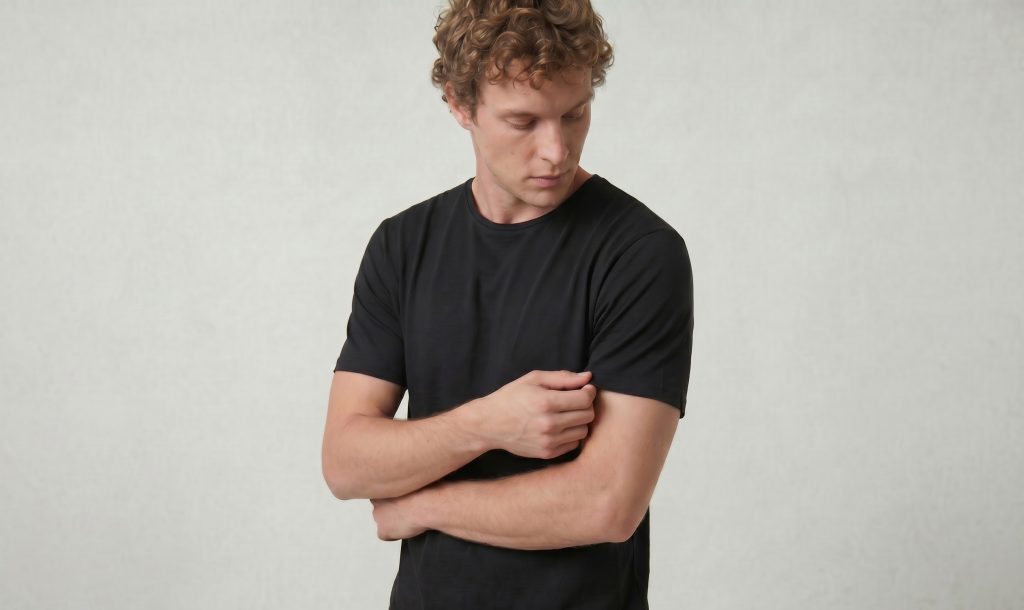
But I'd never assume that spending $60 automatically means getting a better shirt than one costing $30.
1. What Actually Makes a T-Shirt Expensive?
A T-shirt looks simple.
It's essentially a body, two sleeves and a neckline.
But several things can affect the final price.
Fabric
Fabric choice can change how a shirt feels, stretches, drapes and handles moisture.
A traditional cotton tee might prioritize a familiar natural feel.
A polyester-cotton-spandex blend can offer stretch, easier care and different moisture-management characteristics.
A rayon or nylon blend may create a softer, smoother drape depending on how it's engineered.
The fabric itself isn't automatically better because it sounds expensive.
What matters is how it performs for the intended use.
Fit and Pattern Development
This is something I think gets overlooked.
A shirt can use excellent fabric and still fit terribly.
Developing a good fit involves getting the relationship between the shoulders, chest, sleeves, waist and length right.
For me, that's one of the biggest reasons to spend more.

I want a shirt that follows my proportions without squeezing me.
Construction
Look at the stitching.
The collar.
The seams.
The hem.
How everything sits after washing.
Good construction can help a shirt maintain its appearance, although no construction method guarantees that a garment will last a particular number of years.
Brand and Marketing
You're also paying for the business behind the shirt.
Design.
Distribution.
Retail operations.
Marketing.
Brand positioning.
Sometimes that comes with genuine product benefits.
Other times, a substantial part of the price reflects the label.
That's why I focus on the garment itself.
2. Are Cheap T-Shirts Actually Bad?
Not necessarily.
I've worn inexpensive T-shirts that were completely fine for what I needed.
If you're getting undershirts, work shirts or something for occasional wear, there's no reason every shirt needs to cost $50.
But there are tradeoffs worth checking.
Does the collar stretch?
Does the shirt twist after washing?
Does it shrink noticeably?
Do the sleeves flare out?
Does it become rough or uncomfortable?
Does it lose its shape?
Those issues aren't exclusive to inexpensive shirts, but they're worth watching when you're comparing products.
A cheap T-shirt that fits well and lasts can be excellent value.
A cheap T-shirt that you dislike wearing isn't much of a bargain.
3. Why I Think Fit Matters More Than Price
This is where my opinion changed the most.
I've tried shirts that felt incredibly soft but looked terrible on me.
The problem wasn't necessarily the material.
It was the cut.
I have a preference for shirts that fit well through the shoulders and chest while maintaining a cleaner waist.
A traditional straight-cut T-shirt doesn't always create that shape.
Sometimes I size down and fix the waist.
Then the shoulders become too tight.

Other times I size up to get comfortable shoulder room.
Then the torso looks oversized.
Neither is ideal.
That's why I'd rather pay for a better-fitting shirt than a more expensive label.
A $40 shirt that fits your body can look better than a $100 shirt that doesn't.
That isn't a guarantee about every product. It's a reminder that fit is a major part of what you're getting.
4. Is a $40 Men's T-Shirt Worth It?
It absolutely can be.
But it should offer something meaningful for the price.
For example, the Ten/10 Curved Hem Tee is positioned as an athletic-fit everyday shirt.
It uses Ten/10's Velura™ fabric blend of 65% polyester, 30% cotton and 5% spandex.
Its features include four-way stretch, moisture-wicking properties, lightweight construction and a curved hem.
What I like about that approach is that the shirt isn't trying to justify its price through a giant logo.
It's focused on the experience of wearing it.
Does it move comfortably?
Does it follow your shoulders?
Does the waist look clean?
Does the shirt work for casual outings and dinner?
Those are practical benefits.
And they're the kinds of things I'd consider worth paying for if they improve how often I wear the shirt.
5. Is a $60 T-Shirt Worth It?
This is where expectations should increase.
At around $60, I want more than a basic shirt with a premium-sounding description.
I want a noticeable difference in fit, fabric, comfort or construction.
The Ten/10 Heritage Curved Hem Tee is an example of a more premium approach.
It's designed around an athletic form fit with four-way stretch, wrinkle-resistant characteristics and a curved hem.
The point isn't that every man needs to spend $60 on a T-shirt.
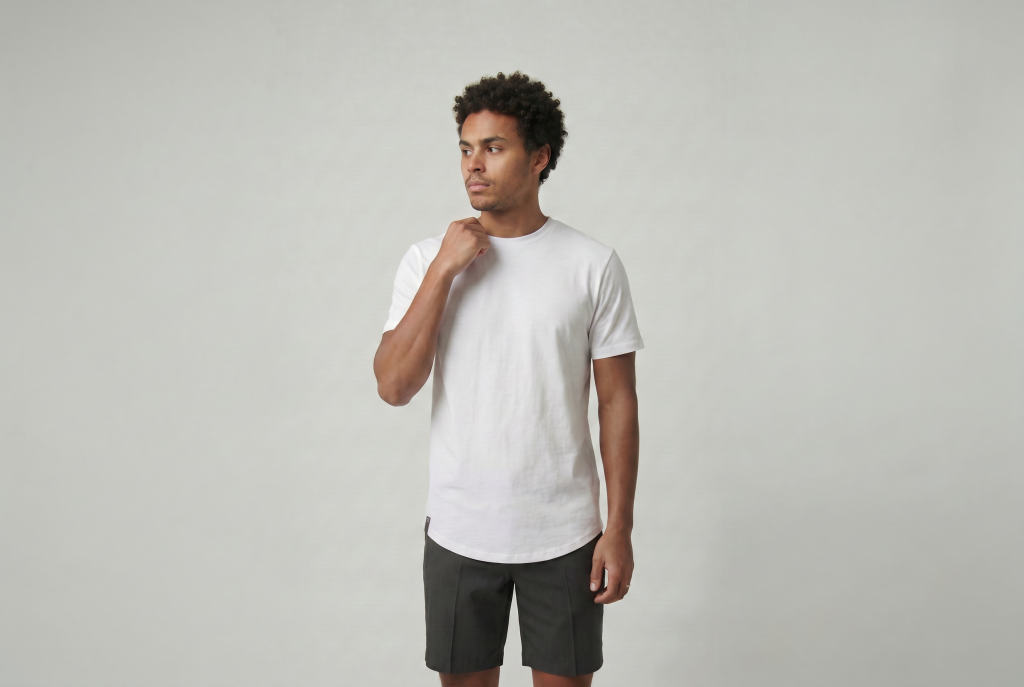
It's that a higher-priced everyday tee should solve something that matters to the person wearing it.
For me, that's usually fit and comfort.
If a shirt looks good on my shoulders, follows my arms and doesn't hang loosely around my waist, I'm more likely to wear it regularly.
And that's where the value starts adding up.
6. Cost Per Wear: The Better Way to Compare T-Shirts
Here's a simple example.
Imagine getting a $15 T-shirt and wearing it 15 times before replacing it.
That's $1 per wear.
Now imagine getting a $50 T-shirt and wearing it 100 times.
That's $0.50 per wear.
| Example | Purchase Price | Number of Wears | Cost Per Wear |
|---|---|---|---|
| Budget tee | $15 | 15 | $1.00 |
| Midpriced tee | $35 | 70 | $0.50 |
| Premium tee | $50 | 100 | $0.50 |
| Designer tee | $120 | 60 | $2.00 |
These are hypothetical examples, not measured durability results.
The calculation is straightforward:
Cost per wear = purchase price ÷ number of times worn.
But there's another factor.
How much do you actually like the shirt?
If I own a $20 tee that sits in my closet because the fit bothers me, it provides very little value.
If I own a $50 tee that becomes my favorite shirt and gets worn constantly, that can be money well spent.
7. How Long Should a Good T-Shirt Last?
There isn't one universal lifespan.
It depends on the fabric, construction, washing habits, frequency of use and what you do while wearing it.
A shirt worn twice a month for dinner has a very different life from one worn every day for physical work.
Instead of relying on claims that a premium shirt will last a certain number of years, I'd monitor its condition.
Does the collar retain its shape?
Are the seams intact?
Does the fabric still feel comfortable?
Is the shirt badly faded?
Has the fit changed?
Does it still look good enough to wear outside the house?
Those are more useful indicators than a fixed replacement schedule.
8. Premium Cotton vs. Performance Blends: Which Is Worth More?
This comes down to preference.
I wouldn't automatically pay more for cotton just because it's natural.
And I wouldn't automatically choose synthetic fibers because they're associated with performance clothing.
Both have advantages.
| Feature | Cotton T-Shirt | Performance Blend |
|---|---|---|
| Feel | Familiar, natural hand | Varies by fiber blend |
| Stretch | Depends on knit/construction | Often enhanced with elastane |
| Moisture | Absorbent | Can be engineered for wicking |
| Drying | Often slower when saturated | Often faster with suitable fibers |
| Appearance | Classic casual | Can offer smoother drape |
| Best For | Traditional everyday comfort | Stretch, travel, active lifestyles |
If I'm wearing a shirt for travel, walking around a city or going directly from daytime plans to dinner, I appreciate stretch and easy care.
If I want a traditional cotton tee, I'd prioritize the fabric feel and silhouette.
Neither category wins automatically.
9. When Is a $100 T-Shirt Worth Getting?
There are situations where it might make sense.
Maybe you want a particular luxury fabric.
Maybe the construction is unusual.
Maybe you're obtaining from a designer whose aesthetic you love.
Or maybe the shirt has a fit you genuinely can't find elsewhere.
That's fine.
But I wouldn't assume the $100 shirt is twice as good as a $50 shirt.
Clothing quality doesn't increase in a straight line with price.
At some point, you're paying more for design, exclusivity, specialized materials or branding.
Whether that's worthwhile is personal.
10. What Should Muscular Men Spend on T-Shirts?
If you have an athletic build, I'd put fit at the top of the list.
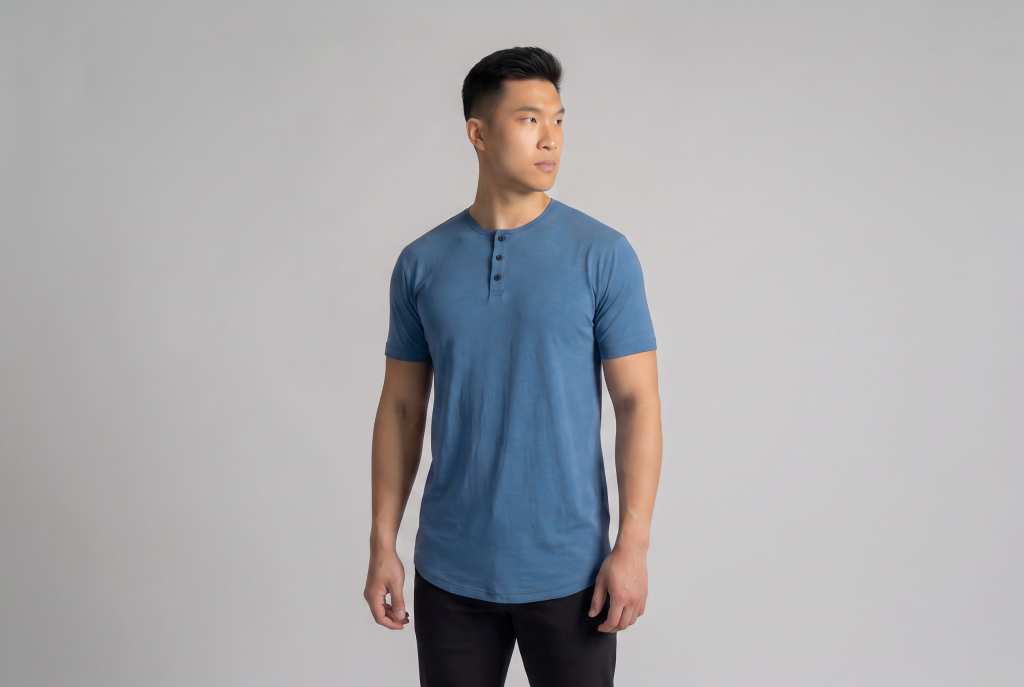
You don't necessarily need the most expensive shirt.
You need a shirt with the right proportions.
For example, if your shoulders and chest are developed but your waist is relatively narrow, a standard boxy cut may not give you the silhouette you want.
That's where an athletic-fit shirt like the Heritage Curved Hem Tee becomes relevant.
I'd look for:
- Comfortable shoulder and chest room
- Sleeves that follow the arms without squeezing
- Less unnecessary fabric at the waist
- Stretch that supports natural movement
- Enough length to maintain coverage
If those things are right, the shirt has already solved several problems.
11. How Many Expensive T-Shirts Do You Actually Need?
Probably fewer than you think.
I'd rather start with three to five shirts that I genuinely like than get fifteen mediocre ones.
For example:
A black T-shirt.
A white T-shirt.
A navy T-shirt.
A gray T-shirt.
Maybe one additional neutral color.
Once you've found the right fit, you can build from there.
This is also where bundles or multipack pricing can make sense, provided you've already confirmed the shirt fits properly.
I wouldn't get five shirts just because the discount looks good.
I'd test one first.
12. Five Questions to Ask Before Getting a Premium T-Shirt
Before spending $40, $60 or $100, I'd ask:
1. Does it fit my shoulders and chest?
Not just while standing still. Move around.
2. Does the waist look right?
Avoid getting a shirt that's too small just to eliminate excess fabric.
3. Do I actually like the material?
Softness, weight, texture and stretch all matter.
4. Can I wear it in multiple situations?
A versatile shirt is easier to justify than one with limited use.
5. Will I want to wear it repeatedly?
That's the question that ties everything together.
Frequently Asked Questions
How much should a good men's T-shirt cost?
A practical shopping range is around $25–$60. Basic tees can cost less, while premium or designer shirts can cost substantially more. Fit, materials and durability matter more than price alone.
Is $50 expensive for a T-shirt?
It's more than a budget basic, but not unusual for premium everyday clothing. Whether it's worth it depends on how well the shirt fits, feels and holds up.
Are $100 T-shirts worth it?
They can be if you value a particular material, design, construction or brand. However, spending $100 doesn't guarantee a better fit or longer lifespan.
What's the difference between a cheap and expensive T-shirt?
Potential differences include fabric, fit development, stitching, finishing, production methods and branding. Price alone doesn't prove quality.
Should I get premium T-shirts or cheaper multipacks?
Premium tees may make sense for frequently worn outfits, while affordable multipacks can be practical for undershirts, workwear or other basic needs.
Is cotton better than polyester for T-shirts?
Neither is universally better. Cotton offers a familiar natural feel, while polyester blends can provide useful properties such as stretch, shape recovery and moisture management.
What is the best price for an athletic-fit T-shirt?
I'd start comparing options in the $30–$60 range, then prioritize shoulder fit, chest room, sleeve shape and waist proportions.
Authority Resources
For independent menswear reviews and comparisons of everyday T-shirts, explore GQ's clothing coverage.
For technical information about cotton fibers, fabric properties and textile performance, CottonWorks is a useful educational resource.
Related Articles
Final Thoughts: Get the Best T-Shirt for Your Body, Not Your Budget Ceiling
So, how much should a good men's T-shirt cost?
For most guys, I'd start around $30–$60.
That's a useful range for comparing premium everyday basics without automatically moving into designer pricing.
But I wouldn't get a $60 shirt just because it's $60.
I'd get it because it fits better.
Feels better.
Moves comfortably.
Works with my wardrobe.
And makes me want to wear it again.
If you want an athletic-fit everyday option, the Ten/10 Curved Hem Tee is worth considering.
If you prefer a more premium athletic silhouette, look at the Heritage Curved Hem Tee.
Both illustrate why I'd rather focus on what a shirt actually delivers than the number on the price tag.
The best-value T-shirt isn't always the cheapest or the most expensive. It's the one that fits you well, meets your needs and earns its place in your regular rotation.